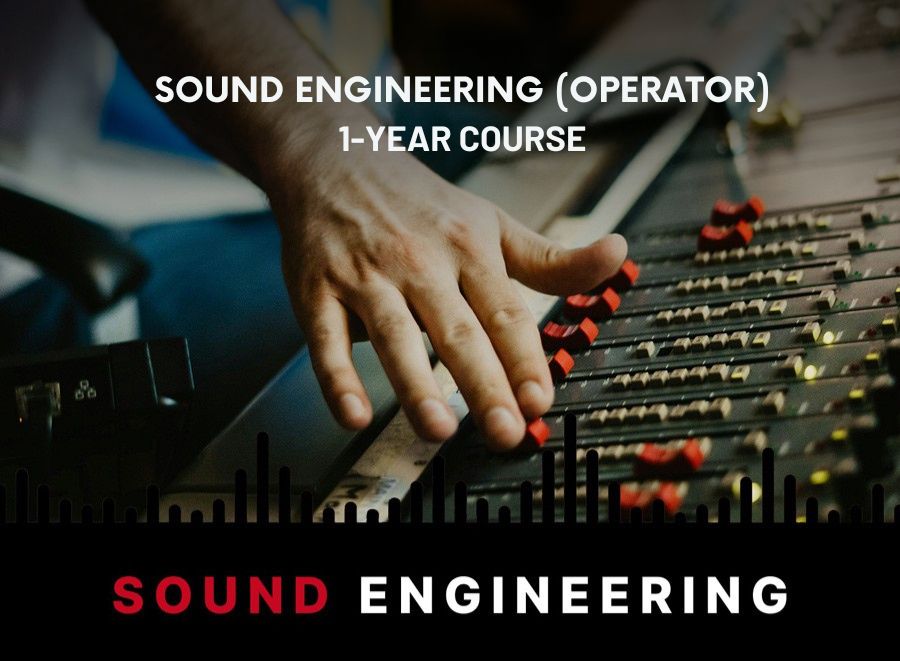
Sound Engineering (Operator) 1-Year Course

Entry Requirements (SA)

Accreditation

Why Choose the Sound Operator Course?

  • It will take you only 1 year of studying to get a job in this exciting Industry
  • You will gain great hands-on experience working on the in-house facilities at CAE. This, in turn will increase employability
  • Experienced facilitators will assist you to exploit your full potential
  • Small class sizes will increase the focus area individually
  • Career-focused learning takes place every day of the week
  • You will be exposed to working with musician and doing real recording
  • After completing this course, you can extend your career opportunities by enrolling for the Radio & Multimedia Content Practioner’s course

2027 1-Year Sound Engineering (Operator) Course

Course Description

Turn Your Passion for Sound into a Career

If you love music, live events, recording, radio, film or working with audio equipment, this course gives you the skills to turn that interest into a professional career.

The Sound Engineering programme combines sound theory with extensive hands-on training. You will learn how to record, edit, mix, master and operate sound equipment using professional studios, software and audio equipment at CAE Institute.

What will you learn?

During the course, you will develop skills in the following areas:

  • sound recording
  • studio production
  • audio mixing & mastering
  • sound editing on a DAW
  • live sound reinforcement
  • broadcast audio production
  • administration and legal guidelines

Graduates are prepared for careers in the fast-growing and modern digital audio and media industry.

What you will learn

During this course, you will develop skills in the following areas:

Audio Fundamentals

  • Theory of sound (Make-up of sound, waveforms, frequency)
  • Acoustics (Standing Waves, Measuring devices, Reverberation time etc)
  • Audio signal flow (Devices sound goes through to reach its end destination)
  • Microphone techniques (Different industry mics are demonstrated)
 

Studio Production

  • Recording techniques (Recording different instruments)
  • Digital audio workstation (Cubase 15 Pro)
  • Audio editing (Working in the audio timeline)
  • Mixing and mastering (balancing signals and output formats)
 

Live Sound

  • PA systems (analogue and digital mixers)
  • Sound reinforcement (Setting up live sound equipment)
  • Stage monitoring (setting up live performers’ stage monitors / in-ears)
  • Live event audio setup and stage plots
 

Learn the Business Side of the Industry

Working in the audio industry is about more than equipment.

  • Professional industry communication
  • Business Management
  • Legal contracts
  • Copyright Law
  • Working as a freelancer
  • Contracts
  • Professional and ethical conduct
 

Audio Equipment & Technical Skills

  • Audio equipment maintenance
  • Troubleshooting sound systems
  • Carry out advanced signal routing
  • Rig and set up live sound equipment
  • Basic electronic maintenance

How the course works

The qualification combines three important parts:

Knowledge Modules
Learn the theory and principles behind sound, audio equipment, electronics and the audio industry.

Practical Skills Modules
Put your knowledge into practice in CAE’s studios and practical training facilities using professional audio equipment and software.

Workplace Experience
Gain valuable exposure to real working environments and experience how the audio industry operates outside the classroom.

This means you graduate with more than theoretical knowledge — you have also spent time working with equipment, completing productions and gaining practical industry experience.

Career Opportunities

After completing the qualification, graduates will has workplace experience to the following industries:

  • Sound Operator (Engineer)
  • Studio Technician
  • Live Sound Technician
  • Radio Studio Operator
  • Podcast Producer
  • Audio Production Assistant
  • Broadcast Technician
  • Audio Advisor
  • Film audio and post-production
  • Your own business
 

These skills are in demand in industries such as:

  • Studio Recording
  • Broadcasting Industry
  • Music Production
  • Film & Television
  • Live events
  • Digital media
  • Advertising Industry

Assessment and Certification

Internal and external assessments will include formative, summative and workplace assessments.

Upon successful completion of the programme and passing the External Integrated Summative Assessment (EISA), you will receive the national occupational qualification awarded by the QCTO.

Faculty

Michael Slater

Principal

Riette Jonck

Administration

Liam Apollos

Lecturer

Andrew Brink

Lecturer

Liam Walklett

Lecturer

Jean-Marc Meyer

Lecturer